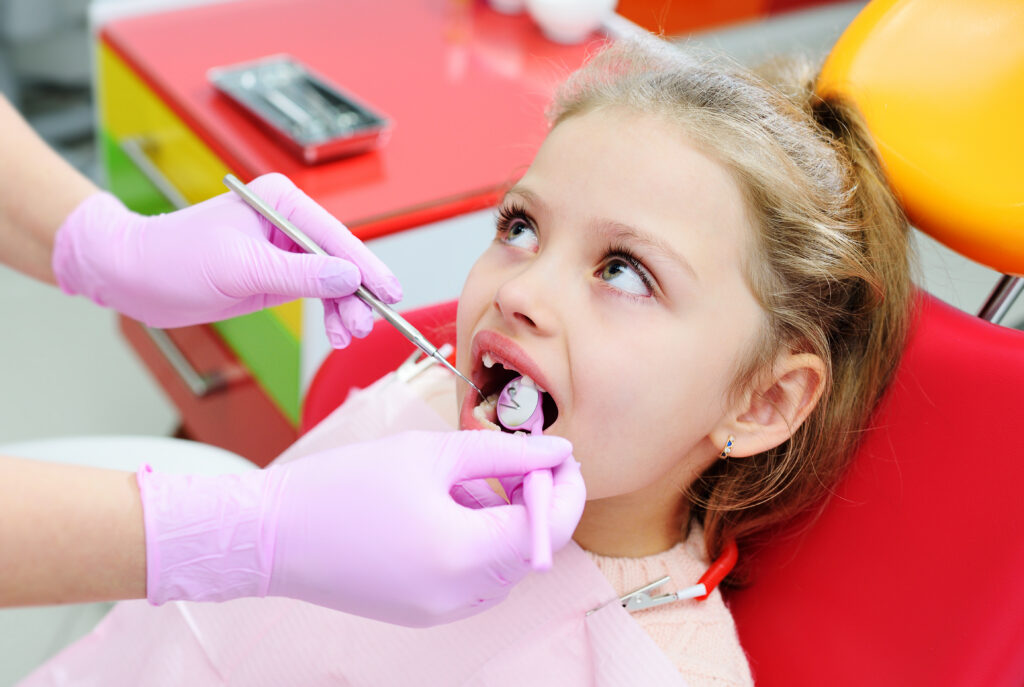
At Orthodontists Associates of Western New York, we believe early detection of bite and alignment issues can help set your child up for healthier dental development. By the time your child’s last baby tooth falls out and the last permanent one comes in, we want to be closer to ideal dental relationships rather than farther away from them. Proactive intervention in young patients helps make that a reality. However, we can only provide early treatment when we identify early orthodontic issues in time. That’s why you should bring your child to see an orthodontist for an orthodontic evaluation by age 7.
Early screenings are now a standard in the United States. However, our practice is led by highly experienced doctors who were among the first in the country to promote the benefits of early orthodontic intervention.
Why Should My Child See an Orthodontist Early?
An early orthodontic evaluation gives us the opportunity to identify and correct issues while your child is growing and developing. The American Association of Orthodontists recommends that patients undergo their first orthodontic evaluation by age 7. At that age, we can identify any issues that might call for more extensive intervention later.
To be clear, early screening and detection don’t mean your child will need to start treatment right away, but a trained eye can make that judgment more carefully.
Age 7 shouldn’t be treated as a hard rule. If you or your child’s dentist notice something concerning before age 7, schedule a free consultation. An early visit can provide answers and help you decide whether monitoring or treatment is needed. Orthodontists are often the first line of defense in identifying tongue thrusting, problems with breathing, and other issues that can slip through the cracks.
Examples of Early Orthodontic Issues
Wondering what orthodontic problems we might catch in an early evaluation? Some early orthodontic issues we commonly see are bite problems, crowding and eruption issues, and habits that affect how the teeth and jaw grow.
Bite Problems: Crossbite, Open Bite, Overbite, and Underbite
We check that the bite, or occlusion, is appropriately aligned. The upper teeth should bite down on the outside of the lower teeth. In a typical bite, the upper front teeth overlap the lower front teeth slightly. We also look for signs of bite problems, which are medically referred to as malocclusions, or bad bites.
Think of the upper jaw like a doorframe that accepts the door closing into it. If a patient has a small upper jaw, it affects how the lower jaw closes into place, and a crossbite often develops. If a child shows an opening in the front of their teeth, this could be the start of an open bite.
Furthermore, if your child is biting too deeply over the lower front teeth, this could be a sign of an overbite.
An underbite is another bite problem we want to see as early as possible. Identifying it early matters because there’s only one way to correct it at a young age: bringing the upper jaw forward and helping it grow. We lose that ability as a child grows, so early intervention supports an effective correction.
Crowding, Spacing, and Tooth Eruption Problems
Early orthodontic screenings can identify crowding, unusual spacing, and eruption concerns before they become more complex. We can evaluate whether there is enough room for permanent teeth. We can also determine whether gaps are part of normal development and check that adult teeth are erupting in the right position and sequence. Early detection does not always mean immediate treatment. Instead, it gives us time to monitor growth, preserve space when needed, and recommend timely care.
Oral Habits That Can Affect Teeth and Jaw Development
We also like to see patients earlier if they show signs of tongue dysfunction or certain habits, like thumb sucking. Over time, these habits can place repeated pressure on the teeth and alter how the upper and lower teeth come together. An orthodontist can sometimes intervene directly by recommending ways to stop the habit. If we recognize a tongue pattern problem we can’t treat ourselves, we can refer the family to someone who can.
Worried About Early Orthodontic Issues in Your Child? Book a Free Screening
When we identify orthodontic issues early, we can address them at the appropriate time. By providing targeted treatment, we can create a better functional relationship between the upper and lower jaw. That functional relationship can promote more favorable growth.
We never charge for any visits until we begin treatment. So it costs you nothing to gain peace of mind, knowing that we’ve set your child up for healthy development. Schedule a free consultation at one of our seven locations near you.