
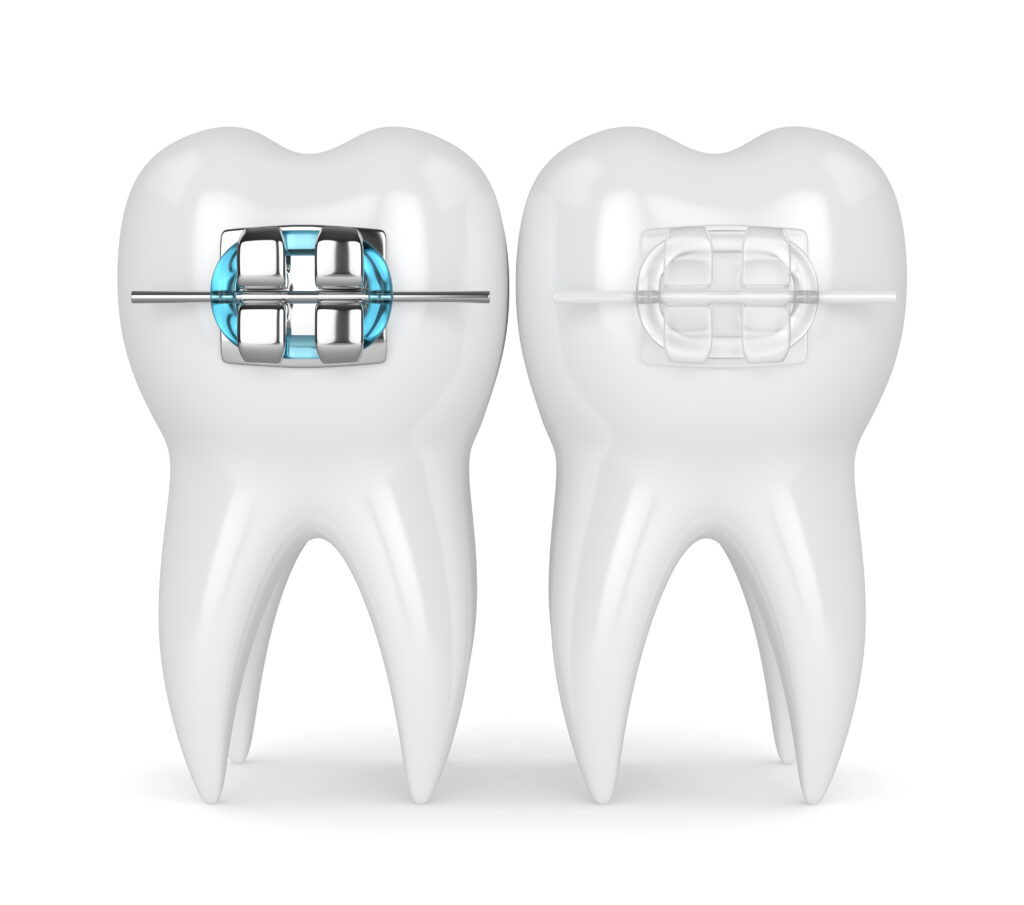
Braces have a greater impact on your oral health than you might think. By straightening your teeth, braces make it easier to brush and floss effectively, helping prevent cavities and gum disease. They can also fix a bad bite, known as a malocclusion. By improving bite problems like overbites or underbites, braces can alleviate pain while chewing and decrease the risk of temporomandibular joint disorder, or TMD, which causes pain in the jaw. But what’s the difference between ceramic braces vs. metal braces? While metal braces might come to mind as the main option, ceramic braces are just as effective and can give you a more discreet look.
How Traditional Metal Braces Work
 When you think of braces, the first image that probably comes to mind is traditional metal braces. These kinds of braces are made of durable stainless steel. Your orthodontist cements metal brackets onto your teeth and uses a metal archwire to connect them. By tightening the wire at regular intervals, the teeth slowly move into the correct position.
Orthodontists use metal braces to correct malocclusions such as overbites, underbites, and crossbites, as well as crowding and spacing issues. This improves the overall functionality of your mouth and the appearance of your smile.
However, some patients are hesitant to get braces because of how they look. If you prefer a less obvious appearance, ceramic braces are a great solution.
Ceramic Braces Are a More Discreet Option
If you want to correct your bite or straighten your teeth, clear ceramic braces offer a way to treat your malocclusions and misalignments with a more discreet appearance compared to metal braces.
Ceramic braces attach to the teeth in a similar fashion, but they use clear components instead of metal ones. Just like their metal counterparts, clear braces adjust, realign, and straighten the teeth. However, the ceramic material provides a more discreet look that blends into the natural color of your teeth.
There’s definitely a demand for less obvious-looking braces. Today, more adults than ever are turning to braces later in life. One in three orthodontic patients is an adult, and they tend to prefer a more discreet option. While kids may enjoy showing off colorful bands and shiny brackets (some even see braces as a rite of passage), adults are usually more focused on the overall look of their teeth and may feel more self-conscious about wearing braces. The less conspicuous look of ceramic braces makes them a popular choice for adult orthodontic patients.
Additionally, since ceramic braces don’t use metal, they’re great for those with metal allergies or sensitivities.
While they have many benefits, ceramic braces do come with some drawbacks to consider. For instance, they’re prone to staining and are more likely to break than metal ones. They can also take longer to move teeth than metal braces. And if ceramic braces break, you might spend even longer correcting your smile. The aesthetic benefits and longer treatment timelines can also make ceramic braces cost more than metal braces.
When To Consider Invisalign®
If you’re dealing with misalignment or a bite issue, the choice isn’t limited to ceramic braces vs. metal braces. For an even less conspicuous appearance, you might consider Invisalign® clear aligners. These are removable aligner trays that fit over your teeth. They look even less noticeable than braces, appearing nearly invisible. But you are expected to wear them for 22 hours a day and use the next series of trays at predetermined intervals. That means there’s more responsibility on you to continue the treatment as planned by your orthodontist.
While Invisalign is a great option, your orthodontist may still recommend braces for more severe malocclusions or complex needs.
Choosing Between Ceramic Braces vs. Metal Braces
So, how do you choose between ceramic and metal braces?
Metal braces are more durable, less expensive, and can move your teeth faster compared to ceramic braces. So if those are your primary concerns, you may want to choose metal braces. If you’d prefer your treatment to be less noticeable, ceramic braces are a better bet.
Ultimately, they offer similar experiences when it comes to correcting your smile. You’ll have food restrictions with both ceramic and metal braces. For example, you should avoid sticky and chewy foods, which can be hard to clean off the braces and can lead to cavities. You’ll also need to avoid crunchy foods, which can put stress on the braces.
For eligible patients, Invisialign clear aligners can help you correct your bite without restricting what you can eat. They’re removable and the least noticeable option, but if you need more advanced correction, you’ll need to start with ceramic or metal braces.
Schedule a Free Braces Consultation
Ultimately, deciding between ceramic braces vs. metal braces (or Invisalign!) depends on your unique needs. At Orthodontists Associates of WNY, we understand that every smile is different. Once we learn about you as a patient, we can recommend the best course of action, whether it’s ceramic braces, metal braces, or something else.
We don’t charge you until treatment begins, so schedule a free consultation today to learn if ceramic or metal braces are right for you.
Come see us at any of our offices in Buffalo, Hamburg, Olean, Lancaster, Niagara Falls, Orchard Park, Dunkirk, and East Aurora.