Braces, expanders, and other oral appliances can correct bite and alignment issues over time, and some appliances use a child’s natural growth. But for patients who don’t see an orthodontist until later in life, jaw growth may be complete. This limits what growth-modifying appliances can achieve. In those cases, surgical intervention may be needed to correct severe jaw discrepancies that orthodontic treatment alone cannot adequately address. But how do these approaches work? Here is surgical orthodontics, explained by Dr. Andrew Dusel, one of the doctors at Orthodontists Associates of Western New York.
If you want to explore your orthodontic options, including surgical approaches, our doctors are happy to assess your needs in a free consultation.
Surgical Orthodontics Explained By an Orthodontist
When does surgical orthodontics make sense? Dr. Dusel explains surgical orthodontics below:
Sometimes, we find that teenagers and adults interested in correcting bite issues, or malocclusions, have finished jaw growth. Once growth is complete, we can no longer use growth-guiding appliances to improve jaw alignment. If orthodontics alone can’t adequately correct the discrepancy between the jaws, we may consider surgical orthodontics alongside braces to improve how the jaws fit together.
This typically involves an oral and maxillofacial surgeon moving one or both jaws so that the teeth and jaws fit together properly. Surgical procedures that correct jaw positioning are known as orthognathic surgery.
Our orthodontists and your oral and maxillofacial surgeon collaborate to recommend the appropriate procedure based on how your jaws fit together and which movements would improve your bite. Below are several surgical approaches that may be part of your treatment plan.
Mandibular Advancement
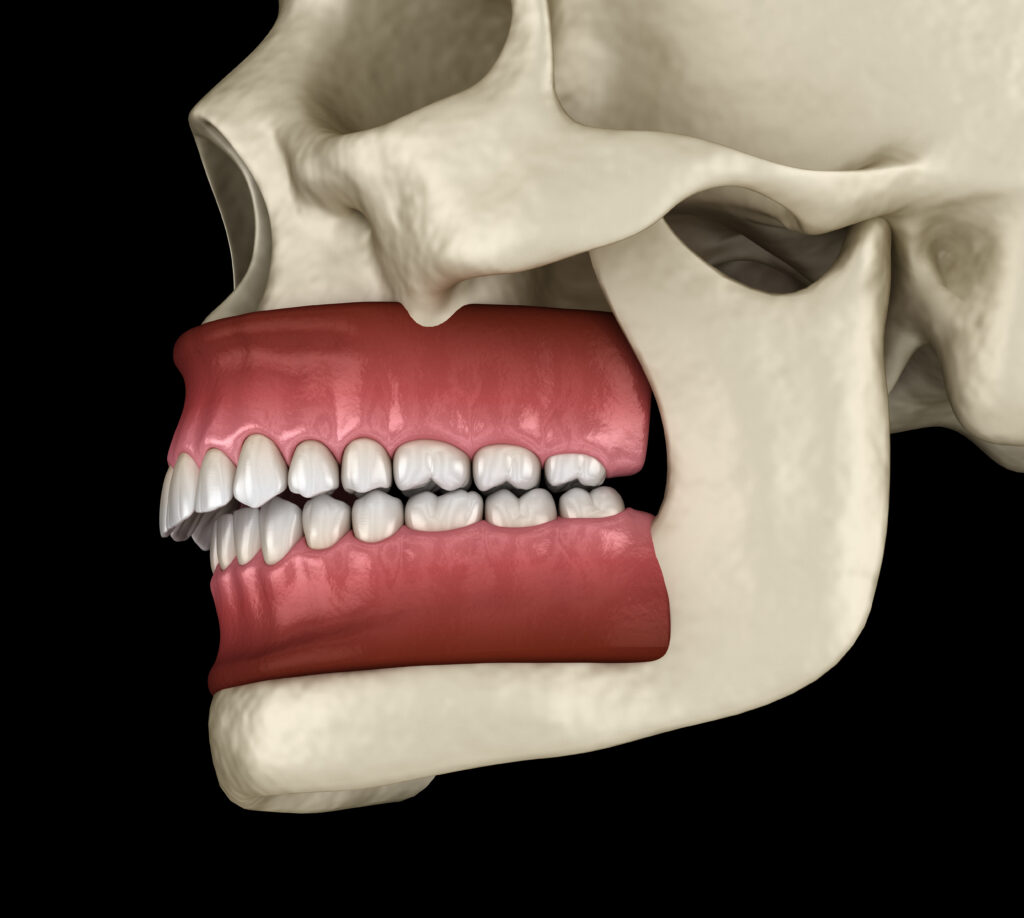
 Mandibular advancement surgery moves the lower jaw forward. It may be recommended when an underdeveloped or recessed lower jaw contributes to a bite discrepancy. An oral and maxillofacial surgeon makes cuts in the lower jawbone and repositions it to improve jaw alignment and the bite.
Mandibular Setback
Mandibular setback surgery moves the lower jaw backward. It may help correct an underbite when the lower jaw extends too far forward. Like mandibular advancement, the goal is to improve jaw alignment and bite.
Maxillary Advancement
Maxillary advancement surgery moves the upper jaw forward. It may help correct an underbite caused by a recessed upper jaw. The surgeon usually makes incisions inside the mouth and cuts the upper jawbone above the teeth so it can be repositioned.
A related procedure, maxillomandibular advancement, moves both the upper and lower jaws forward and can effectively treat obstructive sleep apnea in selected patients.
Maxillary Setback
Maxillary setback surgery moves the upper jaw backward. It may be considered in selected patients whose upper jaw projects too far forward, creating an overbite. The appropriate operation depends on the position of both jaws and how the teeth fit together.
Maxillary Impaction
Maxillary impaction surgery moves the upper jaw upward. It may help correct certain skeletal open bites, in which the upper and lower front teeth do not meet when the back teeth touch. The surgeon removes a planned amount of bone and secures the upper jaw in a higher position. The lower jaw may rotate upward as a result; some patients also need a separate lower-jaw operation.
These procedures address different jaw alignment problems, but understanding the options is only the first step. An evaluation can help determine whether braces alone can meet your needs or whether combining them with jaw surgery may be appropriate.
Book a Free Consultation
With surgical orthodontics explained, you can better understand how braces and jaw surgery may work together to correct bite problems that orthodontic treatment alone cannot fully address. The right approach depends on your specific orthodontic needs, which our orthodontists can assess through an examination and imaging as needed to evaluate how your upper and lower jaws fit together. If surgery is appropriate, we collaborate with oral and maxillofacial surgeons, who perform the surgical portion of treatment.
Our practice is proud to offer the orthodontic component of surgical orthodontic treatment to patients throughout Western New York. We have offices in Buffalo, Lancaster, Olean, Hamburg, Orchard Park, Dunkirk, East Aurora, and Niagara Falls. We don’t charge for consultations until we begin treatment, so you can learn about your options before deciding. Schedule a free consultation today.
Like us on Facebook!
Download Our Free Early Treatment Orthodontics Guide
